What Does Fitness Biology Definition Mean in Evolutionary Science?. If you’ve ever come across the term “fitness” in a biology or evolutionary science context, you might think it refers to physical strength or athletic ability. However, in evolutionary science, the fitness biology definition carries a much deeper and more specific meaning. This concept plays a central role in understanding how species evolve and adapt over time. Let’s dive into the definition and its significance in a way that’s easy to understand and relatable.
1. Understanding Fitness in Evolutionary Terms

In biology, fitness refers to an organism’s ability to survive and reproduce in a specific environment. Unlike physical fitness, which focuses on health or exercise, evolutionary fitness is all about reproductive success.
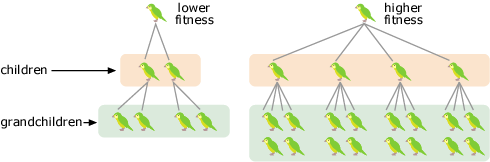
The fitness biology definition hinges on how well an organism’s traits allow it to pass on its genes to the next generation. Organisms with higher fitness are more likely to contribute offspring to the population, ensuring their genetic traits persist over time.
2. The Role of Natural Selection
Fitness is closely tied to the process of natural selection. In a given environment, certain traits provide advantages that improve an organism’s fitness. For example:
- Camouflage: A prey animal with better camouflage is less likely to be eaten, increasing its chances of reproducing. (Read More: Fitness Fiesta Trendy Workouts).
- Speed: A predator that runs faster can catch more prey, ensuring its survival and reproduction.
Natural selection favors individuals with these advantageous traits, gradually shaping the population. Over generations, these traits become more common, while less advantageous traits diminish.
3. Measuring Fitness: It’s All About Reproductive Success

How do scientists measure fitness in biology? It’s not just about survival—it’s about how many viable offspring an organism produces. In evolutionary terms, an organism that lives a long life but has no offspring would have zero fitness. On the other hand, an organism that reproduces frequently, even if it has a shorter lifespan, could have high fitness. (Read More: Heal Hacks Inside Insights).
Scientists often use these measures to evaluate fitness:
- Absolute Fitness: The total number of offspring produced by an individual.
- Relative Fitness: A comparison of an individual’s reproductive success to others in the population.
4. Adaptation: Fitness in Action
Adaptation is a direct result of fitness. As organisms with advantageous traits reproduce, those traits become more common in the population, leading to adaptations that help the species thrive in its environment. (Read More: Bright Life Superb Healthy Advice).
For example, consider the famous case of the peppered moth during the Industrial Revolution in England:
- Before industrialization, lighter-colored moths were more camouflaged on tree bark, making them less likely to be eaten by predators.
- As soot from factories darkened the trees, darker moths gained a survival advantage and reproduced more, shifting the population’s traits over time.
This classic example demonstrates how the fitness biology definition plays out in real-world scenarios, showing how fitness drives adaptation.
5. Misconceptions About Fitness in Evolutionary Science
A common misconception is that “fitness” means “the strongest” or “the fastest.” In reality, evolutionary fitness is about suitability to an environment. Traits that improve fitness in one environment might be disadvantageous in another.
For instance:
- Desert plants have small, waxy leaves to conserve water, a trait that improves fitness in arid environments but would be less advantageous in a rainforest.
- Polar bears have thick fur and a layer of fat for insulation, traits that increase fitness in the Arctic but would be a liability in tropical climates.
Fitness is context-dependent, highlighting how environmental pressures shape the evolution of species.
Conclusion article What Does Fitness Biology Definition Mean in Evolutionary Science?
The fitness biology definition is a cornerstone of evolutionary science, encapsulating the essence of how species adapt and evolve over time. It’s not about being the strongest or the fastest, but about reproductive success and passing advantageous traits to future generations.
Understanding fitness helps us see the dynamic relationship between organisms and their environments, offering insights into the incredible diversity of life on Earth. Whether it’s the peppered moth, polar bears, or desert plants, fitness reveals the intricate ways in which species survive, adapt, and thrive in an ever-changing world.
So, next time you hear “fitness” in a biology context, remember: it’s all about survival, reproduction, and the remarkable story of evolution.